There are likely more hit-the-nail-on-the-head ideas about the future of the book in this five minute video than you'll find at any book or ebook conference over the next wee while. I particularly like Alice, but only because it mirrors my story-telling practice of the last few years.
Saturday

Tales of The Lobster Boy on Facebook
My first novel, Tales of The Lobster Boy, is now a serialized novel on Facebook.
I'd like to say it's the first one, but it's very hard to know. Years ago, Penguin said they were serializing a novel, but to my knowledge, no blogger has been able to find it. What I can say is this: many novels have been part serialized there (there? Where are you when you're on the internet?).
This is one of (and maybe the) first to be completely serialized amongst the blue-shaded friends and followers.
As it has just launched, there's no URL, but search "Tales of The Lobster Boy", and you'll land in the right place. I'm 12 "likes" short of a unique URL, so give it a like.
And, I'll post later on how Facebook pages are so hard to navigate, and why it is in Facebook's best interest to make it difficult to become a Friend of a page.

I'd like to say it's the first one, but it's very hard to know. Years ago, Penguin said they were serializing a novel, but to my knowledge, no blogger has been able to find it. What I can say is this: many novels have been part serialized there (there? Where are you when you're on the internet?).
This is one of (and maybe the) first to be completely serialized amongst the blue-shaded friends and followers.
As it has just launched, there's no URL, but search "Tales of The Lobster Boy", and you'll land in the right place. I'm 12 "likes" short of a unique URL, so give it a like.
And, I'll post later on how Facebook pages are so hard to navigate, and why it is in Facebook's best interest to make it difficult to become a Friend of a page.
Thursday
Sarah Warsop in The Huffington Post

I would not be a good husband if I didn't take a moment to note Sarah Warsop's presence, gracing an article in The Huffington Post.
She rocks!
Wylie and the Odyssey
You won't wander far on the web today without knowing there's a new publishing house / imprint / book label in town - Odyssey Editions, a cooperative venture between Amazon.com and the Wylie Agency.

From the Los Angeles Times:
“London Fields” by Martin Amis
“The Adventures of Augie March” by Saul Bellow
“Ficciones” (Spanish Edition) by Jorge Luis Borges
“Junky” by William Burroughs
“The Stories of John Cheever” by John Cheever
“Invisible Man” by Ralph Ellison
“Love Medicine” by Louise Erdrich
“The Naked and the Dead” by Norman Mailer
“Lolita” by Vladimir Nabokov
“The Enigma of Arrival” by V.S. Naipaul
“The White Castle” by Orhan Pamuk
“Portnoy’s Complaint” by Philip Roth
“Midnight’s Children” by Salman Rushdie
“The Man Who Mistook His Wife for a Hat” by Oliver Sacks
“Fear and Loathing in Las Vegas” by Hunter S. Thompson
“Rabbit, Run” by John Updike
“Rabbit Redux” by John Updike
“Rabbit Is Rich” by John Updike
“Rabbit at Rest” by John Updike
“Brideshead Revisited” by Evelyn Waugh
And here is what is so very clever about this move - every undergraduate student in the English-speaking world (should they read more than one English Lit course) will buy all of these books.
Probably on a Kindle. (Here's what's not clever: they might just download an illegal PDF and read it on an iPad.)
Odyssey Editions will be many things, but they will also be apublisher of text books for the English Lit academic market.
A very smooth move.
Wags guess-timate a 25% market share for ebooks in 10 years. That's as conservative as a Baptist at a Bob Jones bake sale.
From the Los Angeles Times:
Amazon.com now has exclusive rights to sell the e-book versions of some of the best-known titles from top literary authors Philip Roth, Norman Mailer, Vladimir Nabokov, John Updike and more. In an announcement late Wednesday -- shortly after midnight Thursday, East Coast time -- the online retailer revealed that a deal with the powerful Wylie Agency will give Amazon.com the exclusive e-book rights for two years to books such as "Lolita." The e-books will only be available through the Kindle store.The initial Odyssey Editions booklist? Voila:
“London Fields” by Martin Amis
“The Adventures of Augie March” by Saul Bellow
“Ficciones” (Spanish Edition) by Jorge Luis Borges
“Junky” by William Burroughs
“The Stories of John Cheever” by John Cheever
“Invisible Man” by Ralph Ellison
“Love Medicine” by Louise Erdrich
“The Naked and the Dead” by Norman Mailer
“Lolita” by Vladimir Nabokov
“The Enigma of Arrival” by V.S. Naipaul
“The White Castle” by Orhan Pamuk
“Portnoy’s Complaint” by Philip Roth
“Midnight’s Children” by Salman Rushdie
“The Man Who Mistook His Wife for a Hat” by Oliver Sacks
“Fear and Loathing in Las Vegas” by Hunter S. Thompson
“Rabbit, Run” by John Updike
“Rabbit Redux” by John Updike
“Rabbit Is Rich” by John Updike
“Rabbit at Rest” by John Updike
“Brideshead Revisited” by Evelyn Waugh
And here is what is so very clever about this move - every undergraduate student in the English-speaking world (should they read more than one English Lit course) will buy all of these books.
Probably on a Kindle. (Here's what's not clever: they might just download an illegal PDF and read it on an iPad.)
Odyssey Editions will be many things, but they will also be apublisher of text books for the English Lit academic market.
A very smooth move.
Wags guess-timate a 25% market share for ebooks in 10 years. That's as conservative as a Baptist at a Bob Jones bake sale.
Wednesday
Social Marketing Compass
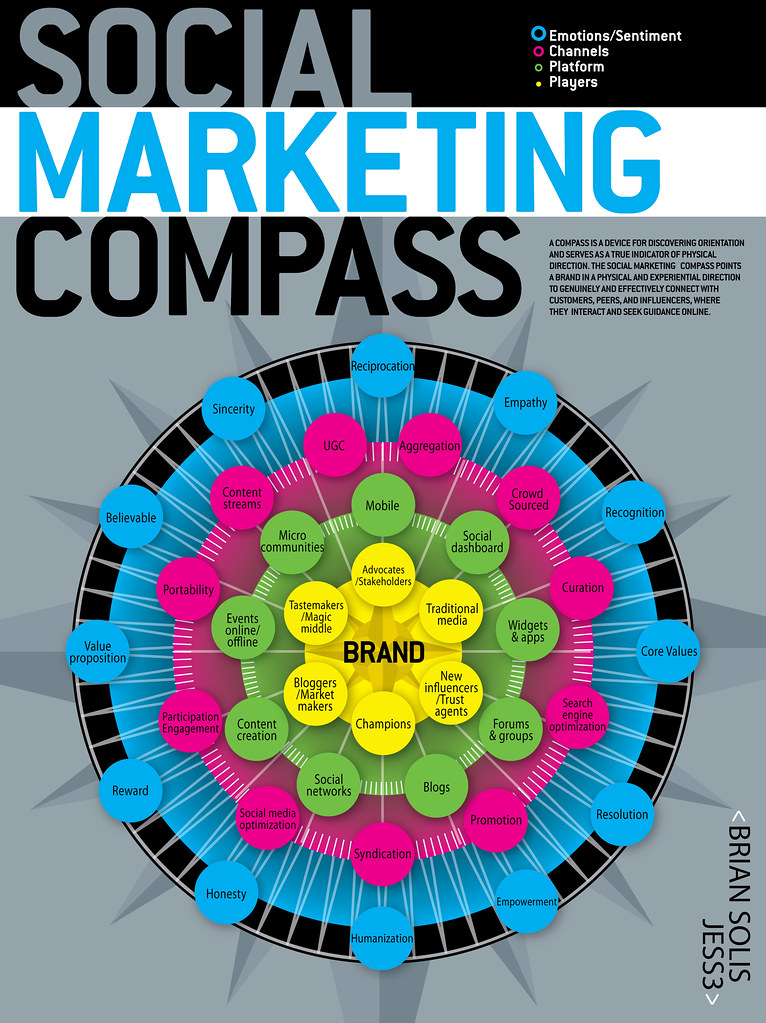
Social Marketing Compass, via Hugh Garry
Let me add, as an aside (and not speaking about either of the linkees), that I value phrases like "Value Proposition" and "Core Values" as much I like the word "allows" when speaking of a software "product".
I can explain to you what they mean, but I am certain they communicate nothing in common usage. They're on a level with brackets and odd capitalizations in postModern(ist)-speak, and only manage to communicate this: "I speak the Shibboleth."
I see a long post about language coming soon....
David Foster Wallace on quiet concentration / Kevin Slavin on putting it in the mix
"The faster things go, the more we feed that part of ourselves .... We don't feed the part of ourselves that likes quiet."
David Foster Wallace speaks here, as part of a longer interview, on American attitudes toward literature (I disagree - the issue is education, not geography), and our growing inability to sit quietly and encounter works of culture, undistracted.
As a fan of Wallace's, and as a man who enjoys a bit of doing nothing, I understand his point. We are changing, and part of that change is that we don't quietly contemplate a single work of art as we once did. We browse while watching television. We chat while reading a magazine. We prefer to listen to audio commentary while contemplating a painting.
The last time went to Cannes, I spoke with an older American producer about ebooks, and shared my desire to create rich media experiences for readers. He was outraged. "The last thing I want messed with is my time alone with a book."
But let me suggest this - if we like to tweet and facebook while we watch television, shouldn't this be seen as a new way of enjoying media? Starling see it that way.
And if, like me, you find that while reading on the iPad, you open Maps to look up a location, or Wikipedia to read background, or Google to understand context, shouldn't we see this as something new - a more committed engagement with literature - rather than something bad?
I'm all for sitting quietly doing nothing. But perhaps, as authors and producers, we should consider our new audience, and invent new ways to serve their engagement with our work.
Kevin Slavin on Starling:
David Foster Wallace speaks here, as part of a longer interview, on American attitudes toward literature (I disagree - the issue is education, not geography), and our growing inability to sit quietly and encounter works of culture, undistracted.
As a fan of Wallace's, and as a man who enjoys a bit of doing nothing, I understand his point. We are changing, and part of that change is that we don't quietly contemplate a single work of art as we once did. We browse while watching television. We chat while reading a magazine. We prefer to listen to audio commentary while contemplating a painting.
The last time went to Cannes, I spoke with an older American producer about ebooks, and shared my desire to create rich media experiences for readers. He was outraged. "The last thing I want messed with is my time alone with a book."
But let me suggest this - if we like to tweet and facebook while we watch television, shouldn't this be seen as a new way of enjoying media? Starling see it that way.
And if, like me, you find that while reading on the iPad, you open Maps to look up a location, or Wikipedia to read background, or Google to understand context, shouldn't we see this as something new - a more committed engagement with literature - rather than something bad?
I'm all for sitting quietly doing nothing. But perhaps, as authors and producers, we should consider our new audience, and invent new ways to serve their engagement with our work.
Kevin Slavin on Starling:
Monday
Failure, Features and Fable

For a man representing a corporate behemoth, Molyneux is incredibly introspective about his practice, as much in this interview as in others we've encountered. Of particular interest are his thoughts concerning why Pixar manages to avoid the Uncanny Valley, what it means to add features just for the sake of adding them, why less blades make a better razor, and how great ideas are hindrances in the face of poor delivery.
Molyneux also takes time to reflect on the future of iPhone gaming. He predicts a future of seven-figure budgets and high barriers-to-entry for iPhone developers. This vision speaks volumes concerning the presence of big brands in the iPhone space. We'd love to see an interview with Molyneaux that tackles the future of casual gaming on the device, as well as the role of indies in relation to AAA developers on the iPhone. His is a brain we'd like to see into.
An excellent interview and write-up by Managing Editor, Phil Elliot.
Wednesday
Would you rather own books or words in a cloud?

Thanks to Ros Lawler over at Random House, we found this link to an article in The Olympian.
Best quote: "[T]he neurological phenomenon of reading is centered in a location of the brain that appears to have no preference for media, other than black words against a white background." From Stanislas Dehaene.
Sunday
Books and Apps

Marcus du Sautoy, the author of The Num8er My5teries: A Mathematical Odyssey through Everyday Life, writes a long and interesting post on apps and their relationship to literature, non-fiction and children's books.
Taking Wolf Hall and Alice's Adventure's in Wonderland (the apps) as starting points, he makes a strong case for the integration of rich media into literature. He briefly suggests that novelists should consider multiple-platforms at the conception of their work, and just as quickly moves on to explore the potential for non-fiction writers.
I wish he had stood still for a moment. In original enhanced fiction, not interactive footnote references, animated illustrations for children, adaptations for the iPad, or video interviews with the author, lies the greatest potential for rich media fiction. Bring on the literary apps - a few text-based literary journals on the iPad just aren't doing it for me.
http://www.guardian.co.uk/books/2010/jul/03/marcus-du-sautoy-apps-books
Principles for Digital Publishing
Stephen Page outlines a few principles for digital publishing in The Guardian. Interesting read.
Here are some:
1. Creating the greatest value for writers should lie in keeping their print and digital publishing in one place, as it is crucial for the promotion, publicity and management of texts – and for fair pricing. Publishers have to be imaginative partners across print and digital.
2. Publishers have to be clear that they will offer a fair return long-term to authors, and review royalty rates sensibly as the market develops. (This is already widespread in new contracts).
3. In the digital world, price is flexible 24/7. Publishers need to become expert in managing, not just setting, price in international markets.
4. The web offers a connection to niche readerships that can be spoken to directly, but only with great care. Publishers need to have direct conversations with readers through all available means, despite the fact that they won't shop with us. Shopping's not the point, connection to audience is the point.
5. Publishers will need to be passionate about boring data and thrilling technology. Excellent metadata – the information that governs and accompanies every copyright in the digital world – is crucial, as is an understanding of new technologies and the creative opportunities they offer writers.
6. Traditional news media has long driven a great deal of book-buying. But the means by which people find reading recommendations have changed and publishers need to join this new conversation while supporting and respecting it.
Wednesday
The Augmented Reality of the Book
The development of multi-platform books (or platform-optimized experiences, if you will) is one of my passions -- not iPad books tacked on with author interviews, but books as immersive experiences, living in the mind, through text and music and art.
The video backdrop and rich soundtrack against which Nick Cave reads The Death of Bunny Munro comes very close to my imagining of this narrative world.
So does this video by Camille Scherrer, a design student at ECAL, the University of Art and Design Lausanne.
One day, when I'm reading a book on the iPad, I want a dark bird to fly across the page.
The video backdrop and rich soundtrack against which Nick Cave reads The Death of Bunny Munro comes very close to my imagining of this narrative world.
So does this video by Camille Scherrer, a design student at ECAL, the University of Art and Design Lausanne.
One day, when I'm reading a book on the iPad, I want a dark bird to fly across the page.

Tuesday
Welcome to the site
Thanks for dropping by. Lots more to come, but let's start with Weird US's excellent introduction to Gibtown, on The History Channel.
Subscribe to:
Posts (Atom)